




Webex Contact Center Implementation & Deployment Services

Enterprise contact center deployments fail for predictable reasons underestimated routing complexity, misaligned SIP trunk configurations, CRM mapping errors discovered during UAT, and go live support gaps that leave operations teams without escalation paths on day one. These failures share a common root cause: implementation managed by generalists rather than certified platform engineers.

Webex contact center implementation is a precision discipline. Maaz Technologies delivers end to end deployment of Webex Contact Center environments, with CWCCE certified engineers managing every phase from solution architecture through production go live. Every deployment is structured, validated, and optimized before a single live call is handled.
Schedule a deployment Consultation

Webex Contact Center Implementation & Deployment Services

End to End Webex Contact Center Implementation

Webex contact center implementation encompasses far more than licensing activation and agent account provisioning. A production ready enterprise deployment requires disciplined engineering across telephony integration, routing logic, IVR design, CRM connectivity, and performance validation all executed in sequence, with each phase validated before the next begins.

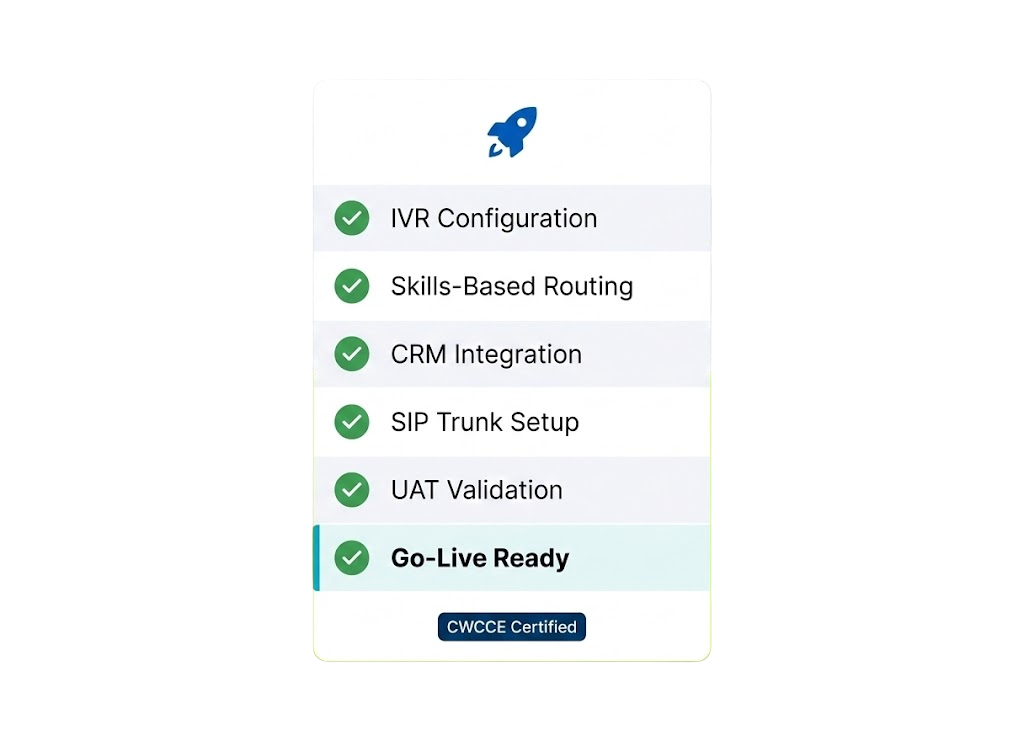
Maaz Technologies structures every Webex deployment around a repeatable methodology that eliminates configuration gaps and reduces go live risk. The engagement covers:

  • Solution architecture design aligned with the organization's channel volumes, agent structure, and IT governance requirements
  • Environment configuration across tenant settings, organizational hierarchy, and security policy enforcement
  • Queue and routing strategy setup reflecting business rules, SLA targets, and skill tree design
  • Agent provisioning at scale, including desktop configuration, profile assignment, and team mapping
  • IVR development and call flow configuration built to the organization's specific interaction design requirements
  • SIP trunk configuration and telephony interconnect validation for hybrid and PSTN connected environments
  • CRM and API integration mapped and validated during implementation (not after go live)
  • Sandbox testing and UAT validation before any production traffic is introduced
  • Go live support with dedicated engineering coverage during cutover

The result is a Webex contact center environment that is operationally ready, technically sound, and configured to perform at the volumes and complexity levels the enterprise actually runs.

Solution Architecture & Configuration

Every Webex Contact Center implementation begins with architecture. Decisions made at this stage determine the performance, scalability, and operational flexibility of the environment for years after go live.

Environment Configuration
Tenant level configuration establishes the foundation of the Webex environment. This includes organizational hierarchy, location and time zone settings, channel configuration, recording policy definition, and security control alignment. Errors at this level propagate through every subsequent configuration layer which is why architecture review precedes any deployment work.
Maaz Technologies conducts a pre-implementation architecture assessment that evaluates the organization's current telephony environment, agent count and distribution, channel volume by type, CRM landscape, and compliance requirements. This assessment produces an architecture design document that governs all downstream configuration decisions.
Queue Setup and Agent Provisioning
Queue configuration defines how the Webex environment distributes inbound contacts. Enterprise environments typically require multiple queues segmented by channel type, customer segment, language, product line, or support tier. Each queue requires defined routing logic, overflow parameters, priority settings, and SLA thresholds.
Agent provisioning at scale requires systematic profile configuration desktop layout assignment, multimedia profile mapping, skill profile association, team membership, and supervisor relationship establishment. Maaz Technologies manages enterprise scale provisioning through structured provisioning workflows that reduce error rates and accelerate deployment timelines.

Testing, Go Live & Post Deployment Optimization

No enterprise Webex contact center deployment moves to production without structured validation. Maaz Technologies applies a phased testing methodology that moves from unit level configuration testing through integrated UAT validation and controlled go live.

Sandbox Testing and UAT Validation

Sandbox environment testing validates individual configuration components before integration testing begins. IVR flows are tested against all defined interaction paths. Routing logic is validated against skill profiles and queue configurations. CRM integrations are tested against representative data scenarios. SIP connectivity is validated for call quality, failover behavior, and DTMF accuracy.

UAT validation involves the organization's contact center operations team executing test scenarios against the configured environment. UAT identifies business logic gaps, interaction design issues, and configuration deviations that technical testing does not surface. Maaz Technologies manages UAT planning, scenario design, issue tracking, and resolution within the implementation timeline.

Go Live Support

Cutover to production is the highest risk phase of any enterprise contact center implementation. Maaz Technologies provides dedicated engineering support during go live, with real time monitoring of queue performance, routing accuracy, IVR completion rates, and integration data flows.

Post go live, the organization enters a stabilization period during which performance data is reviewed against baseline targets. Routing adjustments, IVR refinements, and configuration tuning are applied based on live traffic analysis. This optimization phase ensures the environment performs at its designed operating point, not just at theoretical configuration parameters.

Why Choose CWCCE Certified Engineers for Your Webex Deployment

Enterprise organizations have a clear choice when selecting a Webex Contact Center implementation partner: engage generalist IT staff who have completed vendor onboarding modules, or work with engineers who hold CWCCE certification and have deployed the platform in production enterprise environments.

The difference is measurable. CWCCE certified engineers understand not just how to configure the platform, but why specific configuration decisions produce specific operational outcomes. They recognize when a proposed IVR design will drive abandonment, when a routing strategy will create queue imbalance under load, and when a CRM mapping approach will generate data integrity issues at scale.

Maaz Technologies engineers bring that validated competency to every implementation engagement. No configuration decision is made by trial and error every architectural choice is grounded in certified platform knowledge and production deployment experience.

The outcome for enterprise organizations is a contact center deployment that reaches performance targets faster, requires fewer post launch corrections, and provides a stable foundation for the integration, development, and optimization work that follows.

IVR & Routing Strategy Deployment

Intelligent IVR and routing strategy are the highest value configuration elements in any Webex Contact Center deployment. They directly determine first contact resolution rates, average handle time, customer satisfaction outcomes, and agent utilization efficiency.

IVR Configuration
IVR configuration in Webex Contact Center spans the full interaction design from initial greeting prompts through conditional routing logic, self service flows, authentication integrations, and escalation paths. Production grade IVR design requires understanding both the technical capabilities of the platform and the behavioral reality of the customer population being served.
Maaz Technologies engineers design IVR flows that balance automation depth with escalation clarity. Poorly designed IVR is a leading driver of customer abandonment configurations that over automate or bury escalation paths generate measurable satisfaction degradation. Every IVR build is reviewed against contact volume data and interaction intent profiles before deployment.
Skills Based Routing and Call Flow Configuration
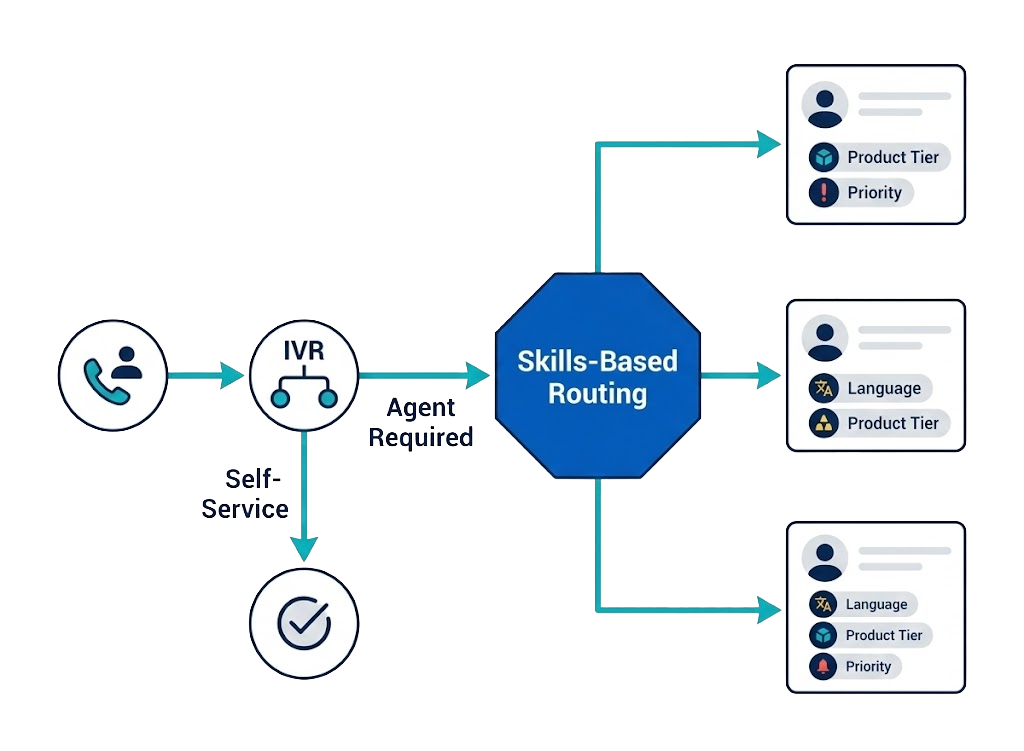
Skills based routing strategy defines how Webex Contact Center matches inbound contacts to the agent best qualified to handle them. Routing strategy in enterprise environments encompasses skill profile design, priority weighting, preferred agent logic, overflow cascade rules, and time based routing variations across business hours, after hours, and holiday schedules.
Call flow configuration maps the logical path every inbound contact follows from channel entry through IVR, queue assignment, agent match, and post interaction disposition. Maaz Technologies designs call flow architecture that reflects the organization's actual operational model, not a generic template adapted post deployment.

CRM & API Configuration During Implementation

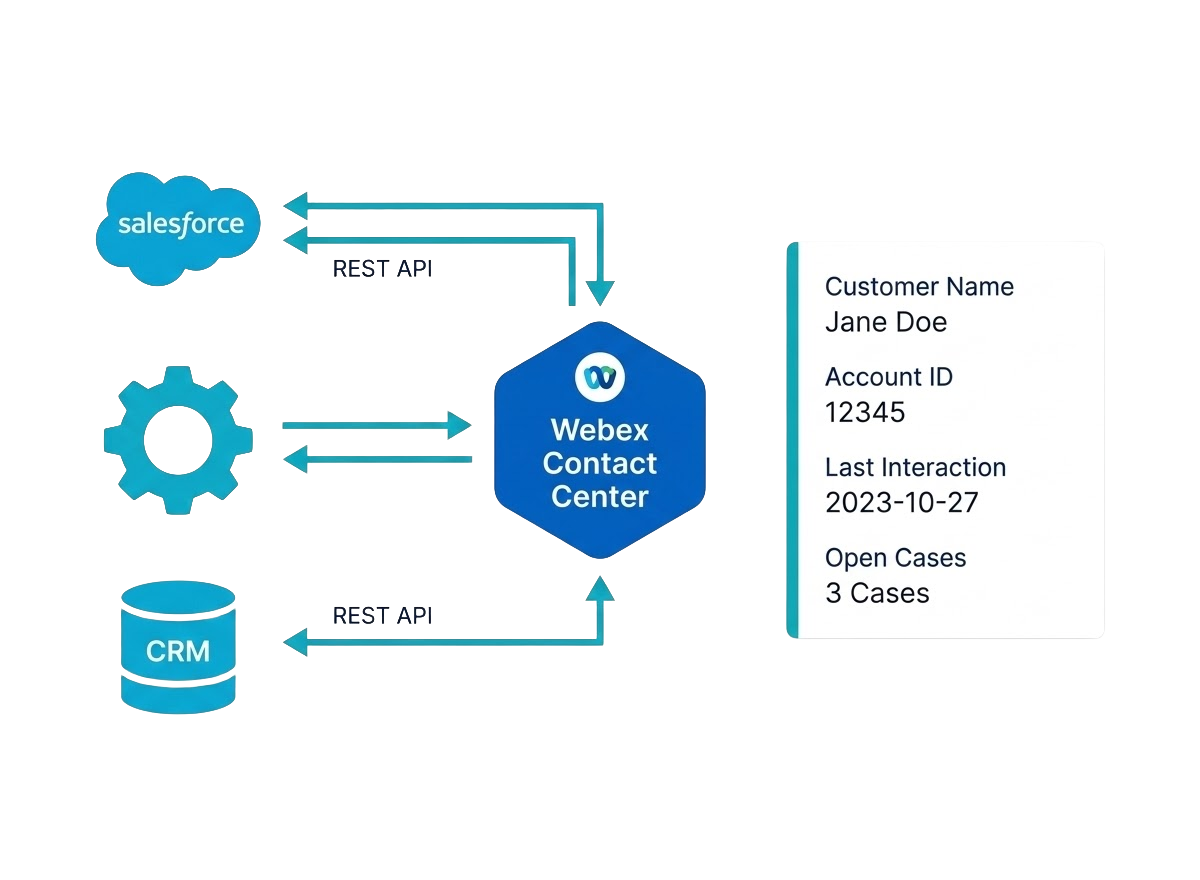
Enterprise contact centers depend on CRM data at the point of agent interaction. Screen pop on inbound contact, interaction history visibility, case creation automation, and post call disposition synchronization are capabilities that require careful configuration during implementation not ad hoc integration after go live.

REST API Configuration and CRM Mapping
Webex Contact Center exposes a REST API layer that enables bidirectional data exchange with CRM platforms, ticketing systems, workforce management tools, and enterprise data environments. REST API configuration during implementation covers authentication setup, endpoint mapping, event subscription configuration, and data field mapping aligned with the CRM schema.
CRM mapping defines which customer data fields are surfaced in the agent desktop panel, which events trigger data writes back to the CRM, and how interaction records are associated with customer profiles across the platform boundary. Errors in CRM mapping during implementation are among the most operationally disruptive issues a contact center can experience post launch agents working without accurate customer context deliver measurably worse outcomes.
Maaz Technologies treats CRM integration as a first class implementation deliverable, not a post deployment task. All CRM mapping is defined, configured, and validated in the sandbox environment before production deployment.
Data Synchronization Validation
Data synchronization between Webex Contact Center and connected enterprise systems is validated through structured test scenarios that replicate live interaction patterns. This includes inbound call screen pop accuracy testing, outbound interaction logging verification, case creation trigger validation, and disposition synchronization confirmation.

Our Implementation Methodology

Maaz Technologies follows a structured five phase implementation methodology for every Webex Contact Center deployment:


This phased deployment model is not sequential in a rigid waterfall sense phases overlap where dependencies allow. The goal is a go-live with no surprises, and a post deployment environment that performs to design specifications from day one

Phase 1: Discovery & Architecture

Current state assessment, requirements gathering, architecture design document, stakeholder alignment on configuration decisions.

Phase 2: Environment Build

Tenant configuration, queue and team setup, agent provisioning, routing strategy implementation, IVR development, and integration configuration in the sandbox environment.

Phase 3: Integration & Data Validation

CRM integration configuration, REST API mapping, data synchronization testing, and third-party system connectivity validation.

Phase 4: UAT & Pre Production Validation

Business scenario testing, performance baseline establishment, issue resolution, and stakeholder sign off.

Phase 5: Go Live & Stabilization

Production cutover, real time monitoring, post launch performance review, and routing optimization based on live traffic data.


Ready to Deploy Webex Contact Center in Your Enterprise?

Implementation quality determines platform performance. Organizations that invest in certified engineering expertise during deployment avoid the costly remediation cycles that follow poorly executed go lives.


Talk to a Webex Implementation Expert
FAQs

End to end implementation covers solution architecture, tenant and environment configuration, queue and team setup, agent provisioning, IVR development, routing strategy configuration, CRM and API integration, sandbox testing, UAT validation, and go live support. The scope varies based on environment complexity, integration requirements, and channel configuration.

Deployment timelines depend on agent scale, integration complexity, IVR design depth, and number of channels being configured. Focused enterprise deployments in environments with limited integration requirements typically complete in four to six weeks. Multi site, multi integration enterprise rollouts follow phased deployment plans spanning two to four months.

Configuration spans tenant settings, organizational hierarchy, queue definitions, routing logic, skill profiles, IVR flow design, agent desktop layout, CRM integration mapping, recording policies, and security control alignment. Each configuration layer depends on decisions made in the preceding layer which is why architecture precedes configuration in every engagement.

Skills based routing configuration requires defining agent skill profiles, assigning proficiency levels, configuring queue routing rules, setting priority parameters, and establishing overflow and escalation logic. This is designed during the architecture phase and implemented as part of the environment build, with validation during UAT before production deployment.

SIP trunk configuration establishes the telephony interconnect between Webex Contact Center and the PSTN or an existing enterprise telephony environment. It involves SIP server address configuration, authentication credential setup, codec negotiation, DTMF signaling parameters, and failover path definition. Incorrect SIP configuration is a common cause of call quality issues in contact center environments certified engineering expertise eliminates these failure modes during implementation.

CRM integration is addressed during implementation as a first class deliverable. Separating integration from implementation creates data mapping gaps that surface as operational issues post launch. Maaz Technologies configures and validates CRM connectivity including REST API setup, screen pop mapping, event triggers, and disposition synchronization within the implementation engagement.

Post go live stabilization is included in every Maaz Technologies implementation engagement. Engineering support remains available during the stabilization period for routing adjustments, IVR refinements, integration corrections, and performance tuning. Structured SLA driven support is available as an ongoing managed service following stabilization completion.

Leave us message

How May We Help You!