







Why Organizations Choose a Certified Webex Contact Center Partner
Technical capability and certified expertise are not the same thing. Many organizations have experienced the
difference after selecting a vendor based on product licensing, only to encounter configuration errors, poor
routing logic, and integrations that fail under production load.
Selecting the right Webex contact center partner determines whether a deployment reaches its designed
performance or stalls during rollout.
Maaz Technologies operates with engineer who have passed the CWCCE (Certified Webex Contact Center Engineer) examination, demonstrating validated competency across:
- Enterprise cloud contact center architecture design
- SIP integration and SIP trunk provisioning within Webex environments
- Contact center compliance configurations aligned with industry regulatory standards
- Routing strategy optimization for high volume and complex skill tree deployments
- Customer journey orchestration across IVR, digital, and agent handled interactions
- SLA driven support frameworks with structured escalation and response commitments
Webex contact center consulting at this level is not limited to deployment. It encompasses pre engagement
architecture review, environment configuration validation, and post deployment performance optimization. As a
specialized Cisco Webex Contact Center provider operating under certified competency, the organization aligns
every engagement with enterprise IT governance requirements and long term scalability planning.
Organizations that have worked with generalist IT vendors often return to certified partners after encountering
routing misconfigurations, SIP provisioning errors, or integration failures that take weeks to resolve. Certified
expertise eliminates these failure modes before go live.
Webex Contact Center Service Offerings
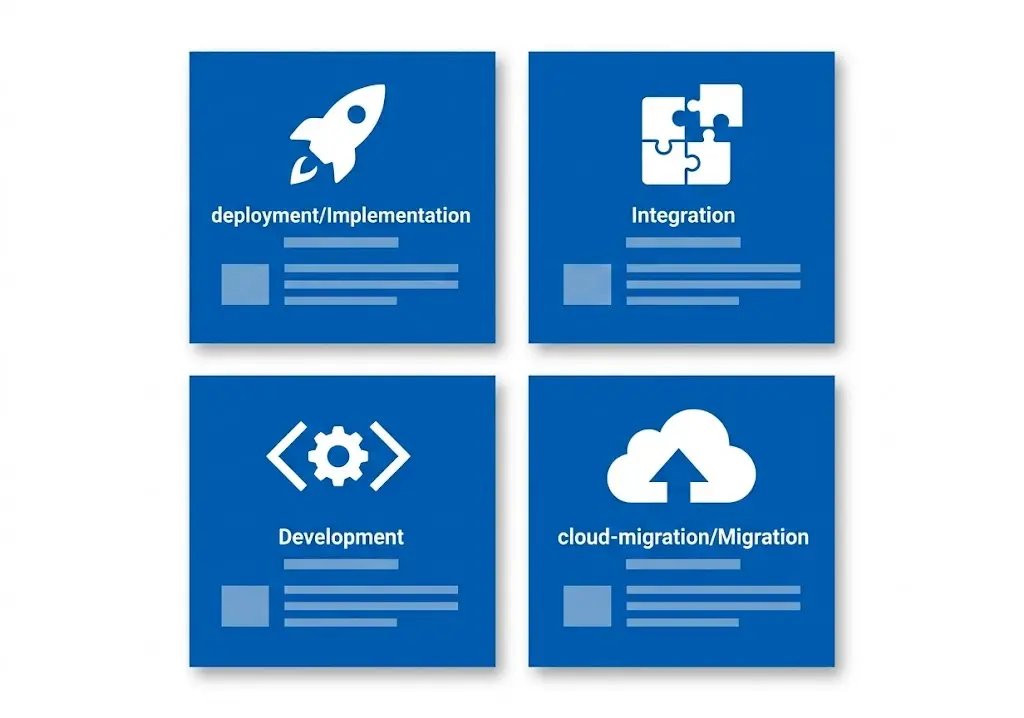
Maaz Technologies delivers Webex Contact Center services across the full implementation lifecycle. Each service area is structured to address a distinct phase of enterprise contact center deployment or optimization and each is supported by dedicated documentation and technical guidance.
- Webex Contact Center Implementation
- Webex Contact Center Integration
- Webex Contact Center Development
- Webex Contact Center Migration
Core Capabilities of Webex Contact Center Services
The Webex Contact Center platform supports a capability set that extends well beyond traditional call center software. Understanding the full scope of what the platform delivers is essential for enterprise technology and operations leadership evaluating platform fit.
Omnichannel Engagement
Intelligent IVR & Skills Based Routing
Skills Based Routing and Queue Strategy
Agent Desktop and Workforce Optimization
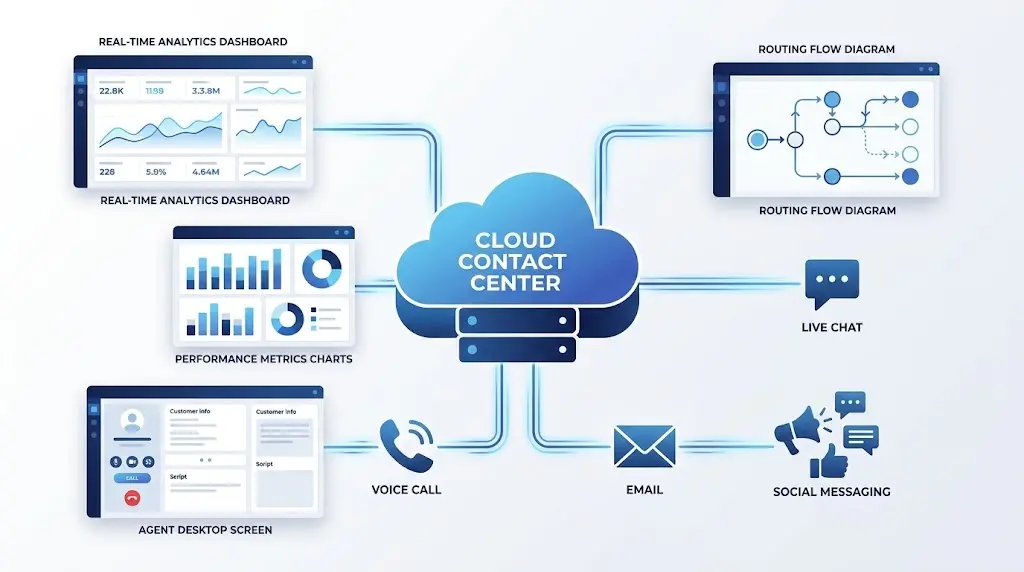
The unified agent desktop integrates CRM data panels, interaction history, screen pop on inbound contact, and customer journey context in a single interface reducing average handling time and improving first contact resolution. Workforce optimization tools provide supervisors with schedule compliance data, quality scoring frameworks, and real time performance visibility. Coaching workflows and performance targets are managed directly within the environment.
Analytics Dashboards and Call Reporting
Business Value of Webex Contact Center Services
- Reduced average handling time
- Improved first call resolution
- Higher customer satisfaction scores
- Enhanced agent productivity
- Improved operational transparency
- Scalable infrastructure for business growth
By aligning cloud contact center services with enterprise objectives, businesses gain measurable operational improvements.
Comprehensive Webex Contact Center Solutions
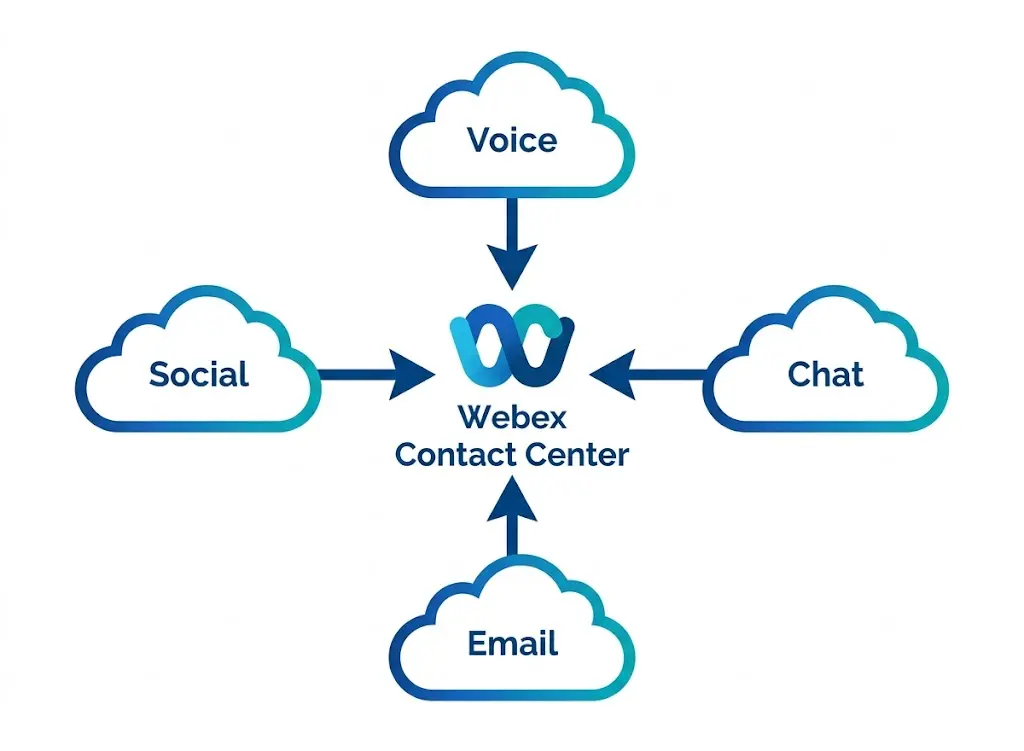
Modern cloud contact center services are not simply a migration of on premises hardware into a hosted environment. They represent a fundamental rearchitecting of how customer engagement is delivered, managed, and measured.Webex Contact Center solutions operate on a true cloud native foundation elastic, distributed, and built for enterprise deployment from the ground up. This architecture gives organizations the ability to scale agent capacity without infrastructure procurement cycles, onboard distributed teams across geographies, and maintain service continuity without dependence on physical data centers.
Enterprise Ready Cloud Contact Center Services
The transition to cloud contact center services is a strategic move toward agility and operational resilience. Cloud native platforms reduce infrastructure overhead while enabling elastic scaling and distributed workforce support.
Key Advantages of Cloud Based Contact Centers
- Reduced capital expenditure
- Flexible agent onboarding
- Business continuity readiness
- Global accessibility
- Secure data encryption standards
- Centralized performance analytics
- Automation enabled workflow optimization
Through cloud architecture design principles, organizations can achieve both cost efficiency and operational excellence.
Industry Applications of Webex Contact Center Solutions
Enterprise adoption spans multiple sectors where performance, compliance, and scalability are critical.
These implementations contribute to broader digital transformation initiatives while strengthening customer experience strategies.
Financial Services
Enhanced compliance controls, secure communication environments, and SLA driven customer engagement models.
Healthcare
Secure communication workflows and centralized patient support systems.
E-Commerce & Retail
High volume customer support with intelligent routing and automation enabled workflows.
Technology & SaaS
Scalable omnichannel engagement with analytics driven customer lifecycle tracking.
Security, Compliance, and Governance
Enterprise contact center deployments cannot treat security as a post deployment consideration. Webex Contact Center embeds security architecture at every layer of the platform.
.
Encrypted communications are enforced across both the voice and digital channels. Secure access controls, role based permissions, and multi factor authentication govern agent, supervisor, and administrator access. Data protection standards align with frameworks relevant to the industries served, including financial services and healthcare regulatory environments.
.
SIP integration configurations are validated against enterprise security standards, with SIP trunk authentication and transport layer security applied to all telephony interconnects. REST API access is governed through token based authentication with scope limited credential models.
.
Security architecture reviews are conducted as part of every engagement not as an audit after deployment, but as a design constraint applied during solution architecture.