Our Partners







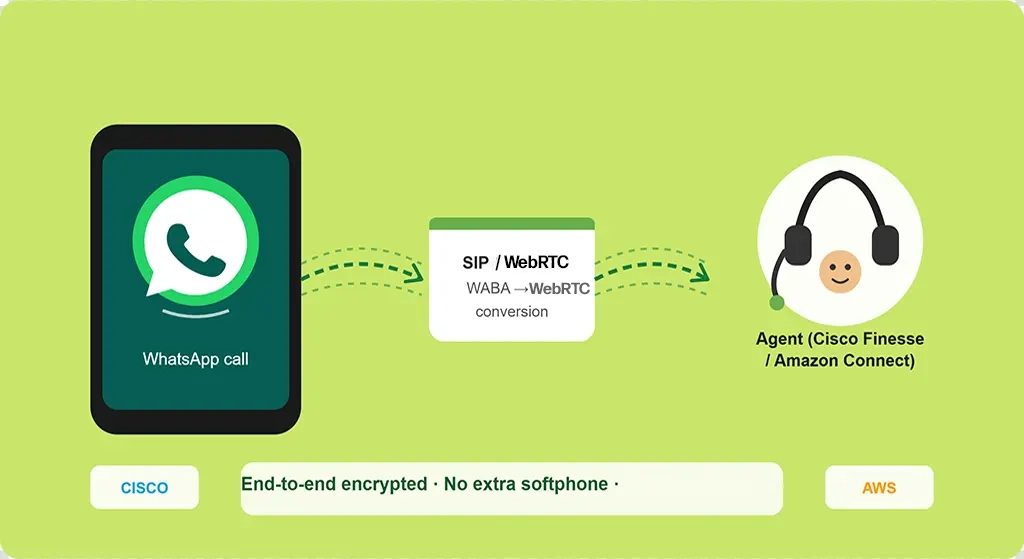
WhatsApp voice calling is added to Cisco or Amazon Connect contact centers via a SIP/WebRTC integration that connects the WhatsApp Business Platform (WABA) to your existing IVR routing engine. Maaz Technologies manages the full deployment, Meta WABA provisioning, SIP/WebRTC configuration, CTI mapping.
The numbers behind why enterprise contact centers are moving to WhatsApp from Meta's own global research.
3 Billion+
Monthly active WhatsApp users worldwide across 180+ countries
Source: Statista & DataReportal, 202573.3%
of consumers prefer messaging when contacting a business across 22 global markets
Source: Meta & Kantar State of Business Messaging, 202569%
of customers say waiting on hold is a waste of time
Source: Meta & Kantar State of Business Messaging, 202572.4%
of consumers are more likely to buy from brands that offer messaging
Source: Meta & Kantar State of Business Messaging, 2025Why Enterprise Contact Centers Are Adding WhatsApp as a Voice Channel
Phone lines are losing ground. Callback rates on traditional IVR menus are falling. Customers in high-WhatsApp markets the Middle East, South Asia, Latin America, and Sub-Saharan Africa consistently rate phone IVR as their least preferred support channel. Yet the overwhelming majority of contact centers still treat WhatsApp as a messaging-only tool, completely separate from their voice infrastructure.
That separation creates a real operational problem. A customer starts a conversation on WhatsApp, escalates to a voice call, and suddenly the agent has no visibility into what was already discussed. The customer repeats themselves. Handle time increases. Satisfaction drops. The data lives in two disconnected systems.
WhatsApp voice calling integration solves this by treating WhatsApp calls as a first-class voice channel inside your contact center platform fully routable, fully recordable, and fully reportable alongside every other voice interaction your team handles.
What makes WhatsApp calling different from standard PSTN or SIP calling
WhatsApp voice calls carry something a regular phone call cannot: the full message context of the conversation that led up to them. When an agent receives a WhatsApp voice call, they can see the chat history in their CRM screen-pop the product the customer asked about, the complaint they raised, the order number they mentioned. The call starts informed. Agents resolve issues faster, and customers never have to repeat themselves.
Beyond context, there is the channel familiarity effect. Customers in markets where WhatsApp is the primary personal communication tool which now includes over two billion daily active users globally are significantly more likely to answer a WhatsApp call from a business they recognize than an unknown number from a traditional outbound dialer. For outbound contact center use cases, this difference in answer rates is substantial.
How WhatsApp Voice Calls Are Routed Into Your Contact Center
The integration works by translating WhatsApp's voice protocol into the SIP/WebRTC standard that Cisco and Amazon Connect already speak. There is no translation layer your agents interact with from their perspective, a WhatsApp call behaves identically to any other inbound voice call in the queue.
WhatsApp Business Platform what enterprise teams need to know before starting
The free WhatsApp Business App is not designed for contact center use. Enterprise voice calling requires the WhatsApp Business Platform (WABA) Meta's API-based tier built for high-volume, programmatic communications.
Enterprise WhatsApp voice calling requires:
(1) an active WhatsApp Business Account (WABA) with Meta Voice approval separate from messaging WABA,
(2) a SIP capable CUBE or gateway for Cisco, or a WebRTC for Amazon Connect,
WhatsApp Voice Calling for Cisco Contact Center Platforms
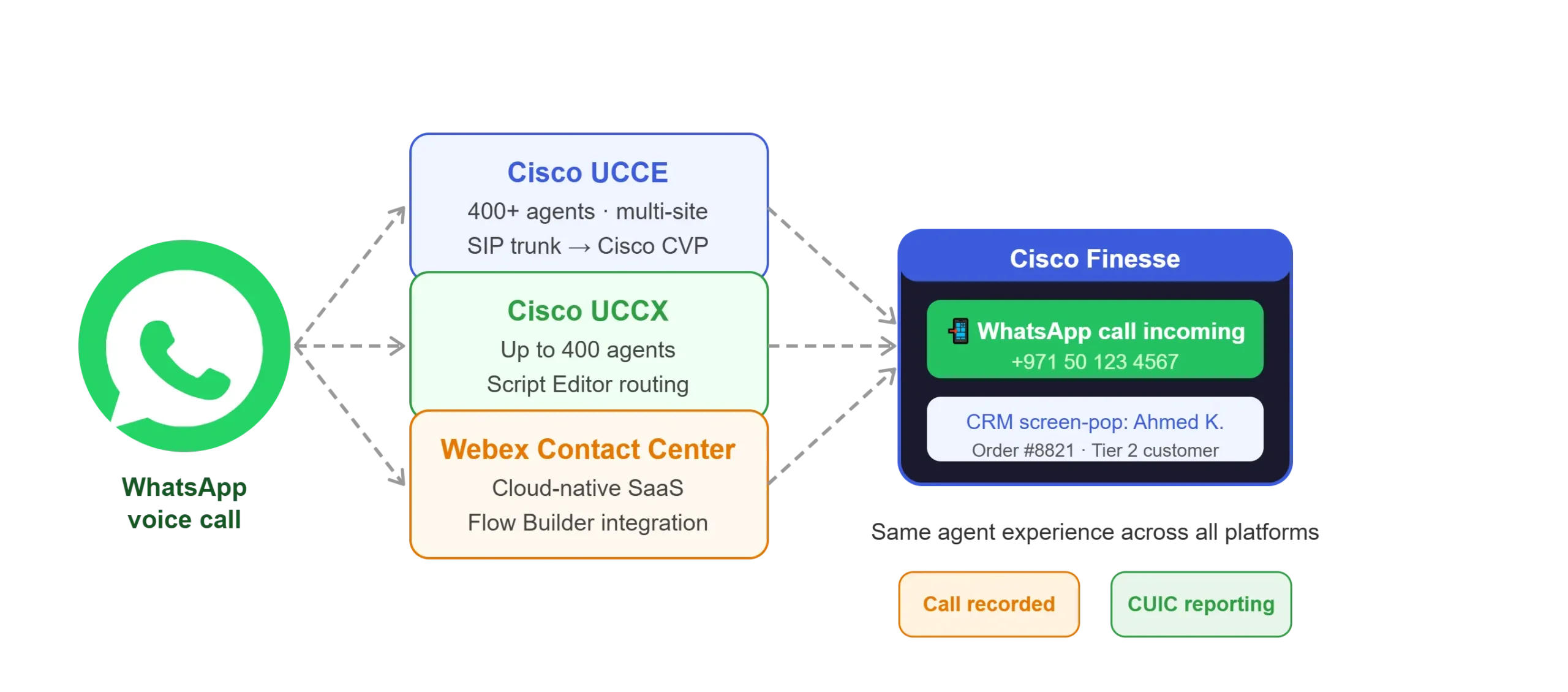
Cisco UCCE, UCCX, and Webex Contact Center have different architectures and serve different deployment scales. The integration approach differs across each platform, but the agent experience is consistent: WhatsApp calls arrive in Cisco Finesse, behave like any other voice call, and are recorded and reported through your existing infrastructure.
Cisco UCCE Unified Contact Center Enterprise
Cisco UCCE is designed for large, multi-site contact centers, typically serving 400 or more agents. WhatsApp calls are delivered to UCCE via a dedicated SIP trunk connected to Cisco CVP. Your existing ICM routing scripts control queue assignment, skill-based routing, and escalation logic no separate routing configuration is needed for WhatsApp calls.
Agents receive calls in their Cisco Finesse gadget using standard CTI events, with a WhatsApp channel indicator displayed in the task bar. If your agents work inside Salesforce rather than Finesse, our Salesforce Service Cloud Voice Cisco integration delivers the same WhatsApp voice channel directly into the Salesforce console. Supervisor capabilities monitoring, barge-in, and whisper coaching all work for WhatsApp voice calls. Recording flows through Cisco MediaSense or your existing third-party recording platform. All WhatsApp call metrics feed directly into Cisco Unified Intelligence Center reports, where supervisors can filter and compare performance by channel.
This integration is compatible with Cisco UCCE versions 12.0 and later. Specific version compatibility is confirmed at the discovery and scoping phase of every deployment.
Cisco UCCX Unified Contact Center Express
Cisco UCCX supports contact centers of up to 400 agents in single-site deployments. The WhatsApp integration for UCCX follows the same SIP-based architecture, with UCCX's Script Editor handling call routing logic rather than CVP. Agents receive calls via Cisco Finesse, with the same channel identification and CRM screen-pop capabilities as the UCCE implementation.
Feature coverage for UCCX includes inbound WhatsApp call routing, Finesse desktop delivery, call recording, and Cisco Unified Intelligence Center reporting. Advanced capabilities specific to UCCE such as multi-site load balancing and certain supervisor reporting features are not available in the UCCX architecture. These differences are discussed during the deployment assessment so you have a clear picture before implementation begins.
Cisco Webex Contact Center
Webex Contact Center is Cisco's cloud-native contact center platform, built on a microservices architecture and delivered as a SaaS solution. WhatsApp voice calling integration for Webex Contact Center uses a different technical approach than UCCE and UCCX, connecting via the Webex Contact Center Flow Builder and utilizing the platform's native channel handling capabilities. The agent experience is delivered through the Webex Agent Desktop. If you are running Webex Contact Center and evaluating WhatsApp voice calling, a separate technical scoping session will establish the exact integration architecture for your configuration.
WhatsApp Voice Calling for Amazon Connect
Amazon Connect is a cloud-based contact center platform built on AWS infrastructure. Its open architecture and native AWS service integrations make it well suited for WhatsApp voice calling, and the integration path delivers unique advantages in AI-assisted call handling that Cisco platforms do not match out of the box. Amazon Connect customers using Microsoft Dynamics 365 as their CRM can combine WhatsApp voice calling with our Amazon Connect Dynamics 365 CTI integration for a fully unified agent desktop.
How the Amazon Connect integration works
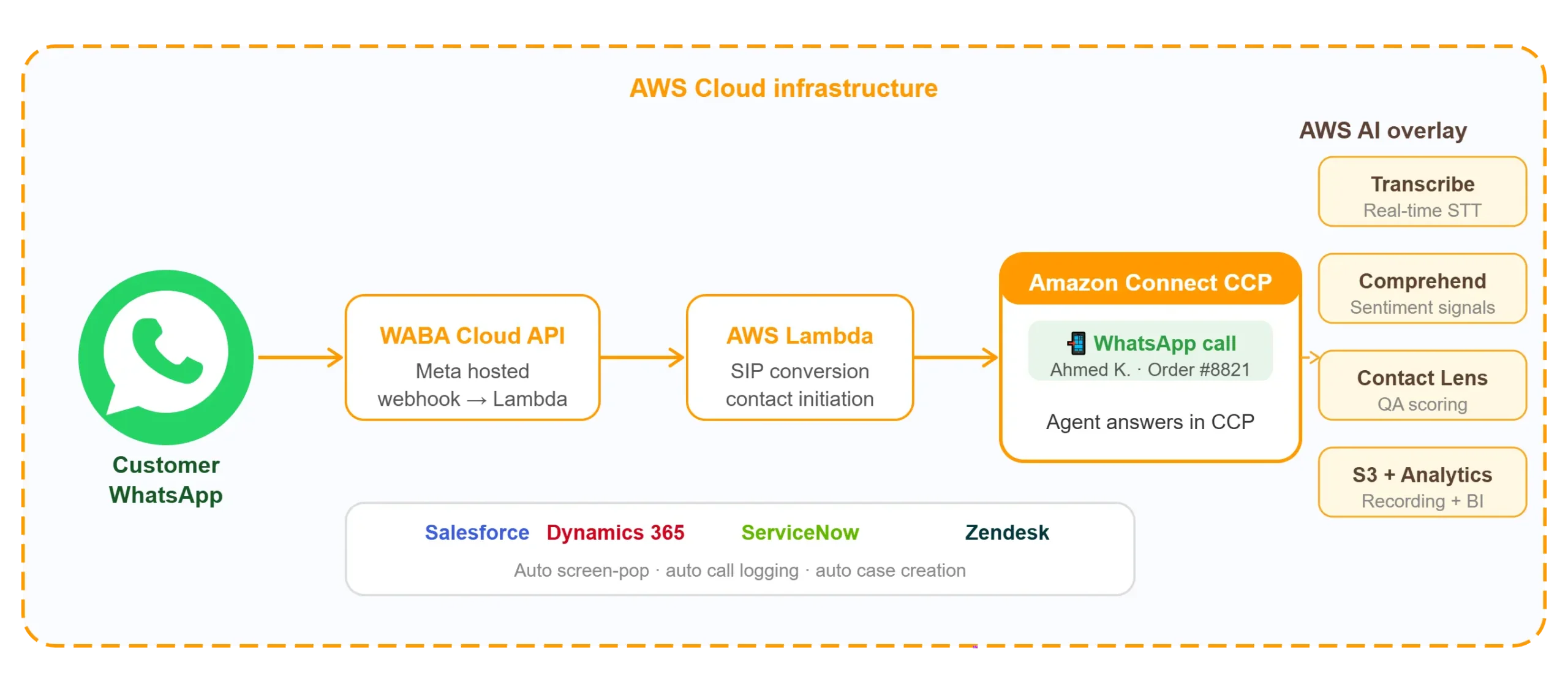
Inbound WhatsApp voice calls arrive via the WABA Cloud API and are processed by an AWS Lambda function that initiates a corresponding inbound contact in Amazon Connect. The Contact Flow handles queue assignment, agent routing, and any interactive voice response logic. Agents receive calls in the Amazon Connect Contact Control Panel (CCP), with a WhatsApp channel label identifying the source.
The integration supports both inbound calls from customers and outbound WhatsApp voice calls initiated by agents, within the WhatsApp Business Platform's policy framework. CRM integration is available for Salesforce Service Cloud, Microsoft Dynamics 365, ServiceNow, and Zendesk through pre-built connectors, as well as custom integrations via Amazon EventBridge.
WhatsApp calling and AWS AI services
Because Amazon Connect is deeply embedded within the AWS ecosystem, WhatsApp voice calls in this integration can benefit from a range of AWS AI services without any additional integration work. Amazon Transcribe provides real-time call transcription during the conversation. Amazon Comprehend surfaces sentiment signals from the transcript, giving supervisors visibility into customer emotion during live calls. Contact Lens for Amazon Connect applies automated post-call quality scoring and keyword flagging across all WhatsApp voice calls, feeding the same quality management workflows your team already uses for other channels.
This combination WhatsApp voice routing with AWS AI overlaid on every call is one of the most compelling operational advantages of the Amazon Connect integration path for organizations already invested in AWS infrastructure.
Business value
Why WhatsApp Voice Calling Improves Contact Center Performance Metrics
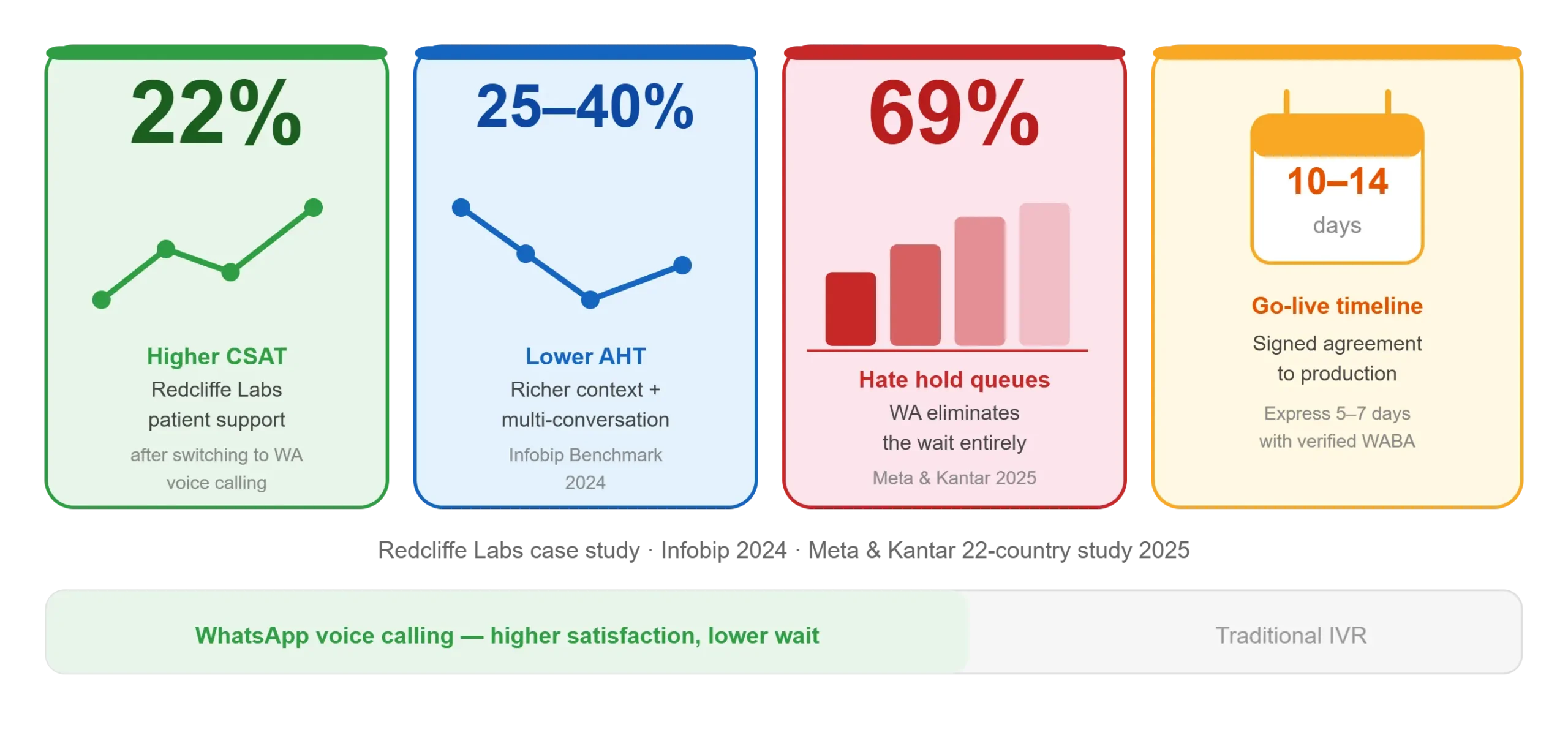
Adding WhatsApp as a voice channel is not a technology project for its own sake. It produces measurable changes in the performance indicators that contact center managers report on handle time, abandon rate, first-contact resolution, and customer satisfaction.
WhatsApp voice calling versus traditional IVR a direct comparison
The argument for adding WhatsApp as a voice channel becomes clearer when you compare it directly against the performance of traditional PSTN and IVR channels on factors that contact center leaders care about.
Industry applications
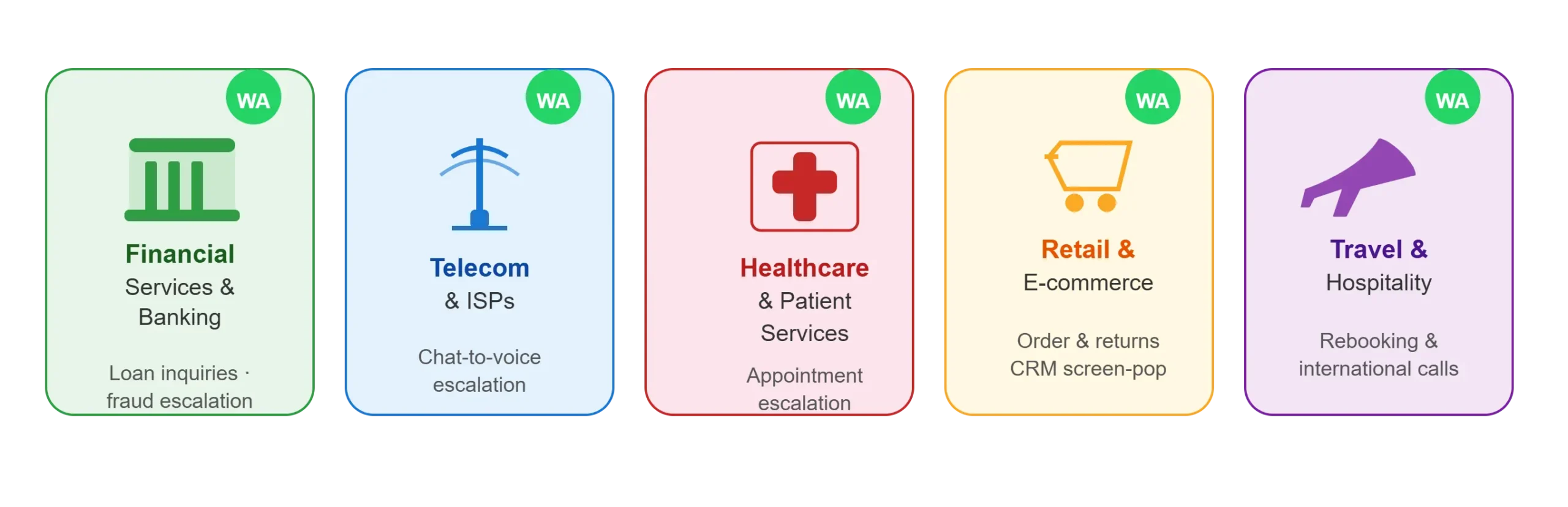
Contact Centers Using WhatsApp Voice Calling Industry Use Cases
WhatsApp voice calling delivers different value in different industries. These are the use cases that demonstrate the most measurable impact in enterprise contact center deployments.
CRM and Business System Integrations for WhatsApp Voice Calls
WhatsApp voice calls deliver the most operational value when connected to your CRM, because the combination of caller identity, message history, and customer record gives agents everything they need before they answer. These are the CRM and business system integrations that come pre-built and tested.
What the Integration Gives Your Contact Center Team
These are the capabilities your operations team, IT team, and agents will work with day to day.
End-to-End Encryption
WhatsApp Business Platform voice calls are encrypted from the customer’s device to the WABA API using the Signal Protocol. Within the Maaz Technologies SIP layer, calls are transported over encrypted SIP-TLS and SRTP. Audio content is never stored unencrypted outside your own infrastructure.
Automated Call Logging
Every WhatsApp voice call is automatically logged in your CRM at the end of wrap-up.The log entry captures the caller’s WhatsApp number, call duration, agent identity, disposition code, and a link to the call recording. No manual data entry is required from agents.
Direct Delivery to Cisco Finesse or Amazon Connect CCP
WhatsApp calls appear in the agent’s existing desktop application Cisco Finesse for Cisco platforms, Contact Control Panel for Amazon Connect. Agents do not need training on a new tool. Call controls answer, hold, transfer, conference, and wrap-up work identically to how they work for any other voice call.
Multi Device Support
WhatsApp calls are handled through your contact center infrastructure, not a mobile device. Agents use their existing headsets and workstations. Customers can call from WhatsApp on any device mobile, tablet, or desktop and the call is received and handled identically regardless of the customer’s device type.
Omnichannel Voice from WhatsApp
Customers call your dedicated WhatsApp Business number, and the call enters your contact center queue exactly like a standard SIP call. No redirect, no callback number to dial, no app switching. One tap from WhatsApp to your agent.
Call Recording and Quality Management
All WhatsApp voice call recordings are captured within your existing recording infrastructure not stored on Meta’s servers. Recordings are accessible through the same interfaces your QA and compliance teams use for all other call recordings.
Supervisor Monitoring and Reporting
Supervisors monitor WhatsApp call queues and active calls in real time using the same tools they use for all other voice channels. For Cisco environments, all WhatsApp call data flows into CUIC, and WhatsApp appears as a named channel in real-time and historical reports. For Amazon Connect, WhatsApp call metrics are available in Amazon Connect Analytics and exportable to Amazon S3 for BI analysis.
Inbound and Outbound Calling
Both call directions are supported. Customers can call your WhatsApp Business number directly (inbound). Agents can initiate a WhatsApp voice call to a customer’s number (outbound) within the WhatsApp Business Platform’s policy framework, which requires an existing conversation thread or an explicit opt-in from the customer. Outbound WhatsApp calls are significantly more likely to be answered than calls from unknown numbers, making this feature valuable for callbacks, appointment confirmations, and proactive service notifications.
CRM Screen Pop with Message Context
When a WhatsApp voice call arrives, a connector looks up the caller’s WhatsApp number in your CRM. If a matching customer record exists, it opens automatically on the agent’s screen before they answer. If no record exists, the connector creates a new contact automatically. The screen pop also includes the customer’s recent WhatsApp message history when available, so the agent understands the context of the call before the conversation begins.
See WhatsApp Calling Working Inside Your Contact Center
Request a Live Demo A 30 minute live demonstration of WhatsApp voice calling in Cisco Finesse or Amazon Connect CCP. Watch the full call flow from customer WhatsApp call to agent desktop to CRM screen pop end to end. Bring your CX and operations leadership.Request Demo →